|
Interpreting and
explaining the infrared
spectrum of cyclopropane
[Author
©
Dr Phil Brown GRIC, PhD:
Doc Brown's advanced level organic chemistry exam revision notes
suitable for students of UK A level chemistry courses & US K12 grade
11, grade 12 and AP honors chemistry courses:
Molecular
spectroscopy analysis of
cyclopentane
[spectra page updated
RE-EDIT]
email doc
brown
Re-edit
infrared spectrum of
cyclo-C3H6
Links associated with cyclopropane
* [privacy policy, cookies
and disclaimer]
This is a BIG
website, PLEASE take time to explore it
See also
comparing the infrared, mass, 1H
NMR and 13C NMR
spectra of propane, cyclopropane and propene
Introductory note on the infrared spectrum of cyclopropane
Students and teachers please note
my explanation of the infrared
spectrum of cyclopropane is designed
for advanced, but pre-university, chemistry courses.
Based in
the infrared spectrum diagram for cyclopropane, only some of the most
prominent peaks for particular bond vibrations are discussed,
particularly if cyclopropane has a functional group with a particular
characteristic wavenumber peak.
The infrared spectrum of
cyclopropane is
unique and the whole, or selected wavenumbers, can be used to
fingerprint its identity, sometimes analysing a mixture
containing cyclopropane or following its change of concentration in a
reaction.
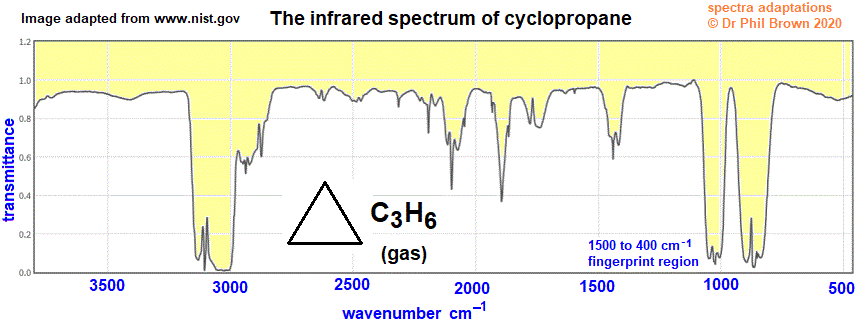
Spectra obtained from a liquid film of cyclopropane. The right-hand part of the of the
infrared spectrum of cyclopropane, wavenumbers
~1500 to 400
cm-1 is considered the fingerprint region for the
identification of cyclopropane and most organic compounds. It is due to a unique set
of complex overlapping vibrations of the atoms of the molecule of
cyclopropane.
Cyclopropane C3H6,
 , 
The molecular structure and
naming of alkanes
Interpretation of
the infrared spectrum of cyclopropane
The most prominent infrared absorption lines of
cyclopropane
C-H stretching vibrations peak at wavenumbers ~3080
to 3040 cm-1 for cyclopropane.
Not sure what vibrations cause the sharp band at
~2200 cm-1.
-CH2- deformation vibrations peak at
wavenumbers 1480 to 1440 cm-1 for cyclopropane.
Cyclopropane shows
-CH2- skeletal vibration absorption bands peaking
at wavenumbers 1020 to 1000 cm-1.
Cyclopropane shows many absorption bands in common with aliphatic
hydrocarbon molecules.
The absence of other specific functional group bands
will show that a particular functional group is absent from the
cyclopropane
molecular
structure.
|
Comparing the infrared, mass, 1H NMR and 13C NMR
spectra of propane, cyclopropane and propene
NOTE: The images are linked to their
original detailed spectral analysis pages AND can be doubled in
size with touch screens to
increase the definition to the original ethane and
ethene image sizes. |
 |
 |
 |
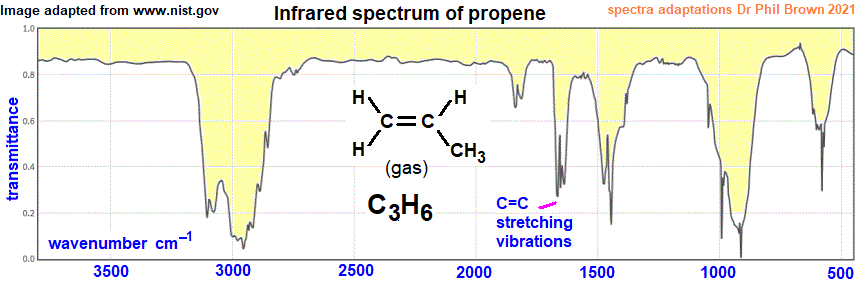
Comparing the
infrared
spectra of propane, propene and cyclopropane.
Cyclopropane and propene are structural isomers of molecular formula C3H6.
Propane
and propene exemplify the infrared spectra of lower members of the alkane
and alkene homologous series of CnH2n+2 and CnH2n
hydrocarbon
molecules where n = 3. |
|
INFRARED SPECTRA
(above):
Apart from the significant differences in the fingerprint region at
wavenumbers 1500 to 400 cm-1, the most striking
differences are: (i) propene shows the characteristic absorption
at ~1700 cm-1 for the C=C stretching vibrations,
absent in the other two spectra, (ii) cyclopropane shows an absorption band
at 2200 cm-1, absent in the other two spectra, (iii)
propane has an absorption band at ~750 cm-1, absent
in the other two spectra. |
 |
 |
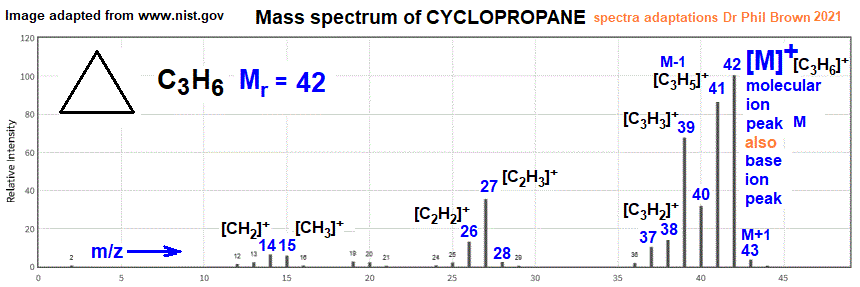 |
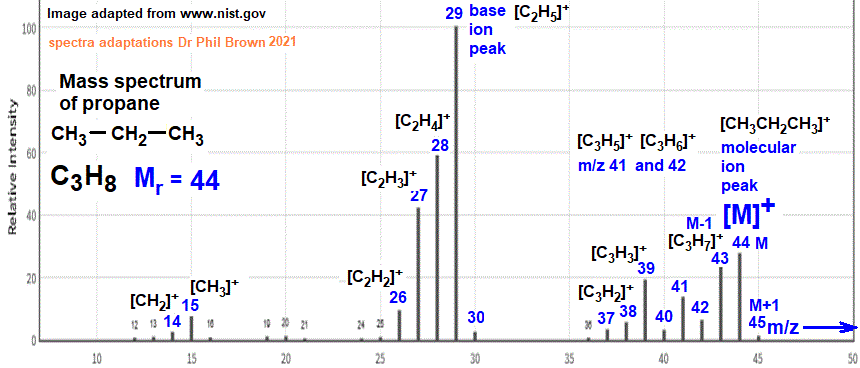
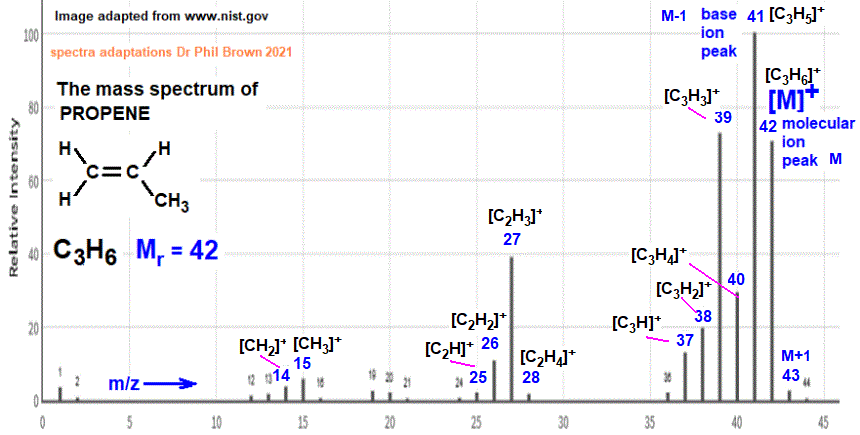
Comparing the
mass
spectra of propane, propene and cyclopropane.
Cyclopropane and propene are structural isomers of molecular formula C3H6.
Propane
and propene exemplify the mass spectra of lower members of the alkane
and alkene homologous series of CnH2n+2 and CnH2n
hydrocarbon
molecules where n = 3. |
|
MASS SPECTRA (above):
All three hydrocarbons show some similarities in their mass
spectra e.g. m/z ions 26 to 28 for [C2Hx]+
(x = 2 to 4) and m/z 14 and 15 ions - but these are found in
most aliphatic hydrocarbon spectra. The molecular ion peaks will
be the same for the isomeric propene and cyclopropane (m/z 42)
but that of propane will be 2 mass units higher at m/z 44. The
base ion peak m/z values are all different, propane 29, propene
41 and cyclopropane 42. |
 |
 |
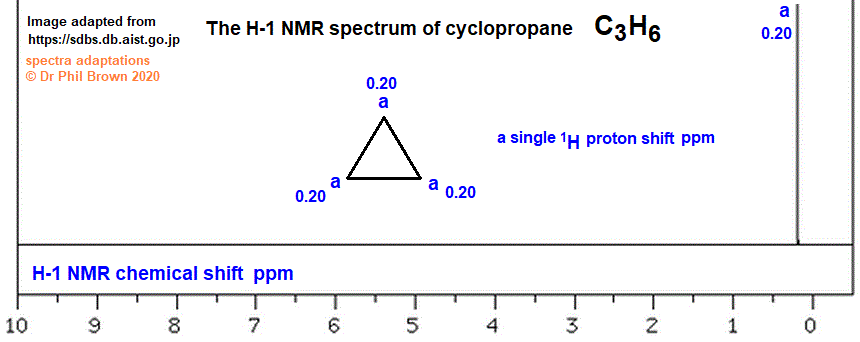 |
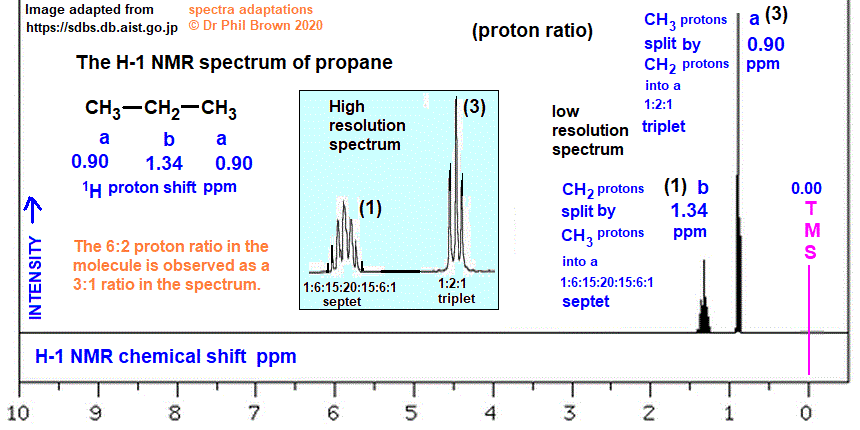
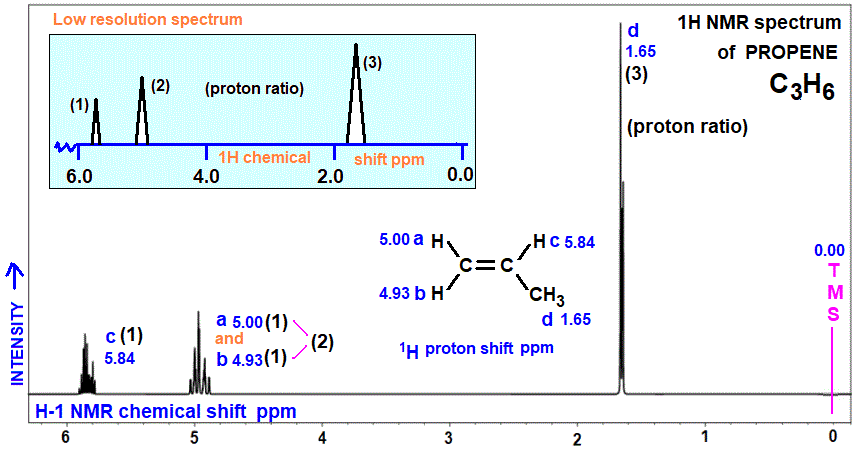
Comparing the
1H proton NMR
spectra of propane, propene and cyclopropane.
Cyclopropane and propene are structural isomers of molecular formula C3H6.
Propane
and propene exemplify the 1H proton NMR spectra of lower members of the alkane
and alkene homologous series of CnH2n+2 and CnH2n
hydrocarbon
molecules where n = 3. |
|
1H NMR SPECTRA (above): The 1H NMR spectra of
all three molecules give different proton ratios i.e. propane
3:1 (actually 6:2 in the molecule), propene 2:1:3 (spectrum and
molecule) and cyclopropane just a singlet for the six protons,
so all three can be distinguished from each other by their
1H NMR spectra.. |
 |
 |
 |
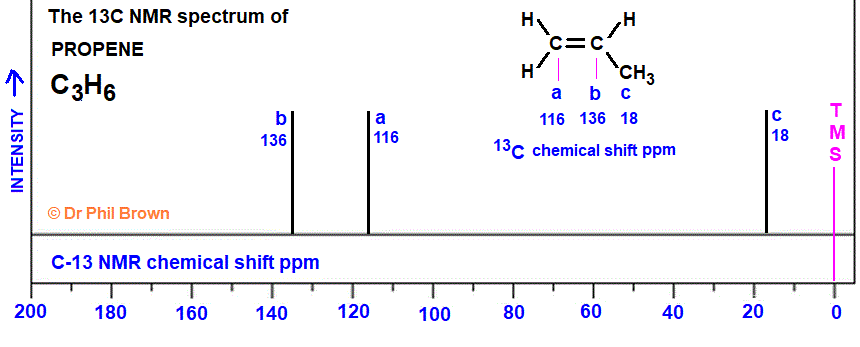
Comparing the
carbon-13 NMR
spectra of propane, propene and cyclopropane.
Cyclopropane and propene are structural isomers of molecular formula C3H6.
Propane
and propene exemplify the carbon-13 NMR spectra of lower members of the alkane
and alkene homologous series of CnH2n+2 and CnH2n
hydrocarbon
molecules where n = 3. |
|
13C NMR SPECTRA
(above): The
13C NMR spectra of the three molecules show different numbers of
carbon-13 chemical environments i.e. propane 2, propene 3 and cyclopropane
only 1, so all three could be distinguished from each other. |
Key words & phrases:
C3H6 image and diagram explaining the infrared spectrum
of cyclopropane, complete infrared absorption spectrum of cyclopropane, comparative spectra of
cyclopropane, prominent peaks/troughs for identifying functional groups in the infrared spectrum of
cyclopropane,
important wavenumber values in cm-1 for peaks/troughs in the infrared spectrum
of cyclopropane, revision of infrared spectroscopy of cyclopropane, fingerprint region analysis of
cyclopropane, how to identify cyclopropane from its infrared spectrum, identifying organic
compounds like cyclopropane from their infrared spectrum,
how to analyse the absorption bands in the infrared spectrum of cyclopropane detection of functional groups in the
cyclopropane molecule example of the infrared spectrum of a
molecule like cyclopropane with a ?
functional group
interpreting interpretation of the infrared spectrum of cyclopropane shows presence
of cycloalkane functional group
Diagram of absorption of wavenumber
peaks in the infrared spectrum of cyclopropane. Characteristic peak wavenumbers in the infrared
spectrum of cyclopropane. Finger print identification pattern using the infrared
spectrum of cyclopropane. Revision notes on the infrared spectrum of
cyclopropane. Matching
and deducing the structure of the cyclopropane molecule from its infrared
spectrum. How do you interpret the infrared absorption spectrum of
cyclopropane How
to interpret the infrared spectrum of cyclopropane Explanatory diagram of the
infrared spectrum of the cyclopropane molecule in terms of its molecular
structure. Listing data of the prominent main wavenumber peaks
troughs in the infrared spectrum of cyclopropane. How to explain the infrared
spectrum of cyclopropane. Use of the infrared spectrum of
cyclopropane, identification
of cyclopropane from its infrared spectrum - fingerprint wavenumber pattern
to identify the cyclopropane molecule. The uses of the infrared spectrum of
the cyclopropane molecule. The distinctive features of the infrared spectrum
of the cyclopropane molecule explained interpretation diagram explaining the
peaks-trough of the transmittance of the infrared spectrum of
cyclopropane
what does the infrared spectrum tell you about the structure and
properties of the cyclopropane molecule? How is infrared spectrum of
cyclopropane used
to identify cyclopropane?
Links associated with cyclopropane
The chemistry of ALKANES
revision notes INDEX
The mass
spectrum of cyclopropane
The H-1 NMR of cyclopropane
The
C-13 NMR spectrum of cyclopropane
Infrared spectroscopy index
ALL SPECTROSCOPY INDEXES
All Advanced Organic
Chemistry Notes
Use My Google search site box
Email doc b:
chem55555@hotmail.com
Index of my advanced
(pre-college/university) organic
chemistry revision notes
Index
of all my spectroscopy pages
Index
of all my isomerism pages
The chemistry of
alkanes and the petrochemical
industry
The
chemistry of alkenes
The
chemistry of haloalkanes
The
chemistry of
alcohols
The chemistry of
aldehydes
and ketones The
chemistry of carboxylic acids and derivatives The chemistry of
organo-nitrogen compounds
The chemistry of
aromatic compounds
Website content © Dr
Phil Brown 2000+. All copyrights reserved on revision notes, images,
quizzes, worksheets etc. Copying of Doc Brown's pre-university
advanced level chemistry website material is NOT
permitted. Exam revision summaries & references to science course specifications
are unofficial. These organic chemistry revision notes on
the spectroscopy of cyclopropane - its infrared spectrum is fully analysed
and
suitable for use of pre-university students studying AQA advanced level
chemistry, Edexcel advanced level chemistry, OCR advanced level
chemistry, IB advanced level chemistry, WJEC (Eduqas) advanced level
chemistry, CIE advanced level chemistry, CCEA advanced level chemistry, US grade 11-12 AP honors
chemistry courses and they will also prove useful to
1st year undergraduate students of chemistry. |
