|
GCSE level physics exam revision notes:
Forces 3. Problem solving: Calculating resultant forces using graphs, vector
diagrams and calculating work done. Lots of examples explained and a 2nd set
of exam practise questions for you to do with worked out answers
[Author
©
Dr Phil Brown GRIC, PhD:
Doc Brown's GCSE physics exam revision notes suitable for students of UK
IGCSE & GCSE level physics courses, ~ US grades 9-10 physics
[forces-3 page updated
RE-EDIT]
email doc
brown: problems?, comments? query?
[privacy & cookies policy and disclaimer]
[ KEY
POINTS and learning objectives for this page, after initial notes]
Other sections on 'forces'
This page will answer
questions such as
What is a resultant force
and how to calculate it?
Why is it a
vector and why must be work with vectors in solving resultant force calculations?
How do we draw scale diagrams to deduce
a resultant force?
What do we mean by balanced and
unbalanced forces?
When dealing with acting forces, what
is an equilibrium?
How do we do
resultant force calculations?
Various
situations and methods of problem solving for multiple force
calculations to obtain a resultant force are explained with
examples.
There are also sets of
resultant force calculations and work done calculations for you to do
and fully worked out answers at the end of the page.
So,
this page contains online questions only.
Jot down
your answers and check them against the worked out answers at the end of
the page
Introduction to
resultant force problem solving calculations
Forces were introduced in "What is a force?"
including contact and non-contact forces AND, importantly for this page, free
body diagrams showing multiple forces on an object.
Force data is useless without its direction
of action.
You not only need to know the value of a force in newtons (N) but the
precise direction or angle of the line of action of one force with respect to at
least one other force.
That is why
force is always a vector - it
has magnitude and direction!
When a body is subjected to multiple known
forces (usually >= vectors in newtons) how can we deduce and calculate the net
resultant force and its direction?
It is possible to replace multiple forces
acting at a single point with a single force known as the resultant force.
Some resultant forces are easily deduced with
a simple addition or subtraction.
For example imagine an object of weight 12
N falling vertically in air.
If the air resistance opposing the fall was 5
N, what would be the resultant force? Quite simply it would be 12 - 5 = 7 N.
So the object would continue to fall and
accelerate due to the 7 N resultant force.
Other more complicated situations require a scale drawing showing all
the forces involved and the direction (e.g. angle) in which each individual
force acts.
From such graph work you can measure and
calculate the resultant force and its direction of action.
If the resultant force is zero,
this is described as an equilibrium situation - a position of balance.
Examples of using graphical scale
drawings to determine a
resultant force and its direction and to test for an equilibrium situation are
explained below.
Example 1.
Two forces at 90o to each other (left scaled diagram)
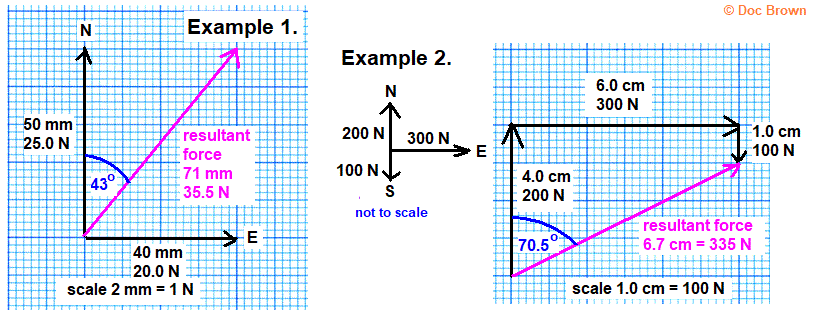
Suppose two forces act on an object, a 25
N force in the north direction, and 20 N force at 90o to the
east.
In this case, using a scale of 2 mm = 1
N, you draw vertical line 50 mm long and connect to it a horizontal line of
40 mm.
The two lines form half a rectangle, so,
to get the resultant line, imagine the other half of the rectangle (or draw
it in faintly) and draw the resultant line diagonally across the rectangle.
In this case I made it 71 mm long, giving
a resultant force of
35.5
N.
With a protractor you can then measure
the angle of the resultant force, which is
43o
from the north.
Example 2.
Three forces acting on an object (right scaled diagram)
This is a bit more tricky.
Here an object is subjected to a 200 N
force to the north, a 300 N force to the east, and a 100 N force to the
south.
This is illustrated by the 'not to scale'
sketch on the side.
You might need to draw a starting sketch
like this if all the information comes as text only!
Using a scale of 1.0 cm = 100 N.
You draw a vertical line 4.0 cm long in
the north direction.
Then at top of this line draw a
horizontal line 6.0 cm long for the east force of 300 N.
OK, so far, as in example 1., but, now
draw the line of the 3rd (south force) at the end of the east force line.
You now draw the resultant diagonal line
from the bottom of the north line to the bottom of the south line.
(You should note the reduction of the
north force is 100 N because of the opposing 100 N south force).
The resultant diagonal line is 6.7 cm
long, which equals
335 N.
With a protractor you should get a
measured angle of
70-71o
from the north
(I calculated it to be 70.5o,
using trigonometry - see
APPENDIX 1, which is
another way of solving these problems if it can be reduced to a right angled
triangle situation).
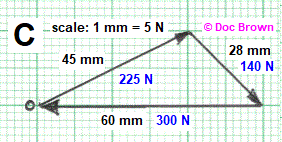
Example 3. An equilibrium or 'state of
balance' situation
 In
example 3 I want you to imagine the 300 N force acting in the opposite
direction to two other forces, 225 N and 140 N at an angle to each other.
In this case there is NO net
resultant force (other than zero!). The object is then described as being in a state of
equilibrium (or balanced) and would remain stationary.
This illustrates a method of deducing a force needed
to produce an equilibrium situation involving three forces e.g. you
might be given two and have to work out the 3rd force needed to balance
the other two forces.
Example 4. Pulling an object along (but watch out for forces that
don't count!)
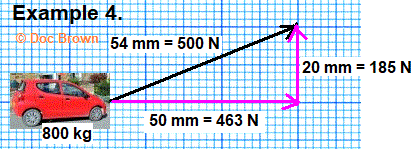
Imagine a car of mass 800 kg being towed
by a breakdown truck.
The tension in the towing cable is 500 N
at the angle indicated in the diagram.
The weight of the car will be 800 x 10 =
8000 N (gravity is ~10 N/kg).
Resolve the towing force into its
vertical and horizontal components.
The graphical drawing uses a scale of 54
mm = 500 N.
This comes out of the way I've done the
diagram i.e. I didn't choose a more convenient scale!
Scaling down for the vertical force
component of length 20 mm: 500 x 20 / 54 =
185 N
Scaling down for the horizontal force
component of length 50 mm: 500 x 50 / 54 =
463 N (in the towing
direction)
Note that the weight of the car
acting in a vertical direction due to gravity does NOT affect these force calculations.
Forces that act at 90o to the
direction of motion, do not contribute to the horizontal force you are calculating here
in the direction of motion.
Unless the front of the car is
physically lifted off the ground, it cannot affect the vertical component
force.
Example 5.
Multiple forces acting on an object - is the resultant force zero (equilibrium)
or otherwise
5a. An equilibrium situation, a
state of balance with no resultant force other than zero from multiple
forces

Consider four forces of 31, 36, 22 and 28
N, all acting on the same object and at four different directions.
This is shown as the left vector diagram.
To check if there is a non-zero resultant
force, you draw all the forces tip-to-tail to create a loop - note all the
forces are drawn clock-wise to fit in with the force arrow direction.
This is the right vector diagram.
Here there is a complete loop i.e.
you end up at the starting point, this means there is no effective
resultant force and the object is in a state of equilibrium.
5b. A non-zero resultant force from
multiple forces acting on an object, not an equilibrium

Consider four forces of 32, 42, 45 and 36
N, all acting on the same object and at four different directions.
This is shown as the left vector diagram
(scale 1 mm = 1 N, 2 mm squares, 2 mm = 2 N).
Again, to check if there is a non-zero
resultant force, you draw all the forces tip-to-tail to create a loop - note
all the forces are drawn clock-wise to fit in with the force arrow
direction.
This is the right vector diagram. There
is actually a resultant force of 10 N (10 mm) to the horizontal right.
Here there is NO complete loop
i.e. you do NOT end up at the starting point, this means there is an
effective resultant force and the object is NOT in a state of
equilibrium.
Set A QUESTIONS for
you to do
Examples of problem
solving to calculate a resultant force using graphs or other vector diagrams
See also
work done
calculations in Appendix 2.
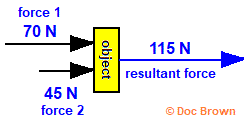
 A Q1.
Two forces acting on an object.
What is the resultant force and direction of movement
of the object?
ANSWER |
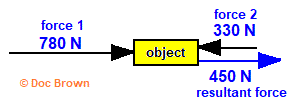
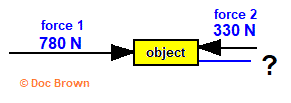 A Q2.
Two forces acting in parallel but opposite directions
What is the resultant force and direction on the object?
ANSWER |
 A Q3.
Multiple forces acting on an object
Given
the free body diagram, what is the magnitude and direction of the
resultant force.
ANSWER |
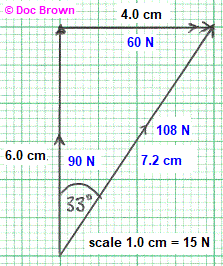
 A Q4.
Resolving two forces that are not parallel
Imagine an object is subjected to a northward force
of 90 N and a due east force of 60 N.
Deduce the magnitude of the resultant force and
its angle with respect to due north.
There are two approaches you can follow.
(i) Using graph paper and a suitable scale or (ii) using
the trigonometric calculation method (see
APPENDIX 1):
ANSWERS |
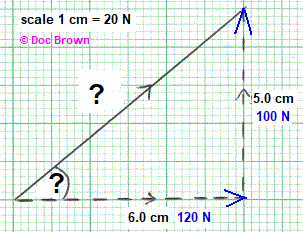
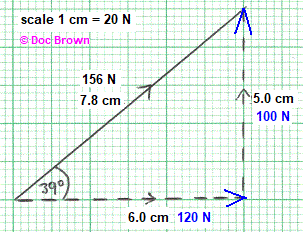
A Q5.
Resolving a forces into two forces at right angles to each other
Imagine a force of 156 N acting at an angle
of 51o from the vertical 'north'.
Deduce the component vectors for due north and due
east quoted on the diagram.
ANSWERS
|

A Q6.
Variations on two forces.
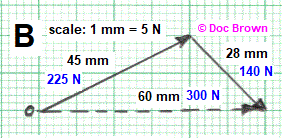
(a) Situation A: A pulling force of 225 N is acting on
an object at an angle of 27o to the horizontal. At the same
time it is also subjected to another pulling force at 45o to
the horizontal (as shown in the diagram).
Deduce the resultant force and direction quoted on the diagram.
(b)
Situation B: However, you can
avoid the parallelogram of forces diagram by drawing the force diagram
in a simpler way - can you arrive at the same answer as (a)?.
(c) Situation C:
I want you to imagine the 300 N force acting in the opposite
direction. Deduce the
resultant force and direction?
ANSWERS
|
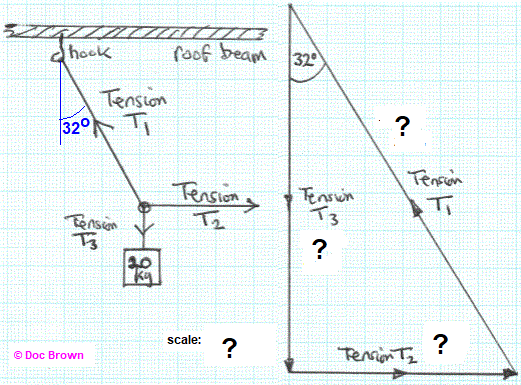 A Q7.
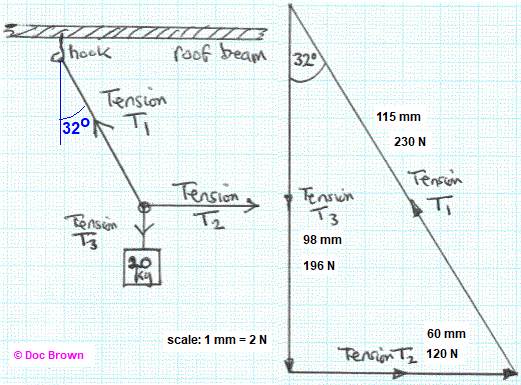
A hanging weight, tensioned horizontally
A mass of 20 kg is suspended from a beam by a wire at
angle of 32o away from the vertical (see diagram). The
tension in this wire is T2. The same 20 kg weight is pulled to one side
by a horizontal string with a tension T2. (g = 9.8 N/kg)
Using a graph and suitable scale calculate the tension force in
(a)
the wire (T1)
(b) in the string (T2).
ANSWERS |

A Q8.
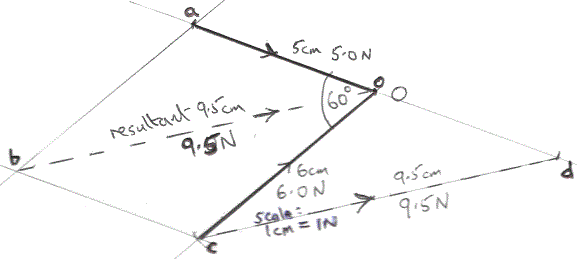
Resolving two converging forces
Two
forces, 5.0 N and 6.0 N, act on an object at an angle of 60o
between the lines of action (as in the diagram).
Calculate the resultant force on the object O at
point o.
ANSWERS |
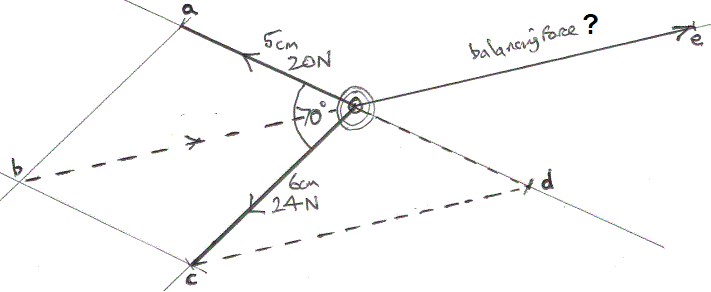
A Q9.
Calculating a 3rd force required to establish an equilibrium
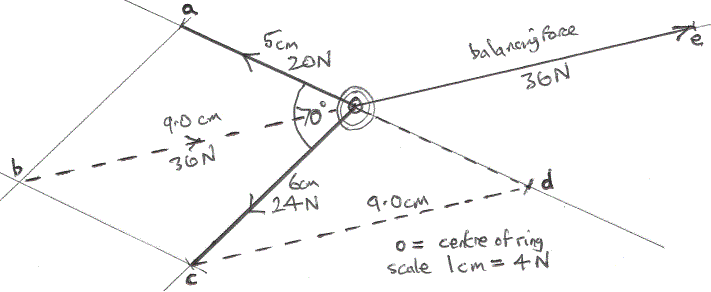
Two wires with pulling force tensions of 20 N and 24
N are pulling on a metal ring. If the angle between the lines of action
is 70o calculate the force needed on the 3rd wire on the
right, to stabilise the ring to give an equilibrium situation.
ANSWERS |
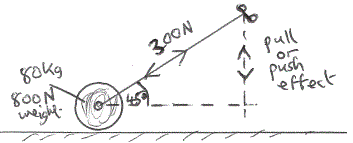 A Q10.
A push and pull grass roller!
A roller
of mass 80 kg (~800 N) is pushed or pulled with a force of 300 N acting at an
angle of 45o to the horizontal grass surface.
Ignore friction effects in this question.
(a)
Calculate the pulling force in
the horizontal direction.
(b) Calculate the vertical force of the roller on the
grass when it is pushed.
You first need to calculate the vertical force
involved due to the person pushing or pulling the roller (call it Fp).
(c) Calculate the vertical force of the roller on the
grass when it is pushed.
ANSWERS |
 A Q11.
A suspended microphone!
A microphone of
mass 750 g is suspended by a wire at 25o to the vertical
(tension T2, diagram) and pulled to the right by a horizontal cord
(tension T1, diagram). (Take g = 10N/kg)
(a) Calculate the tension in the wire holding up
the microphone.
(b) What tension must be applied to the horizontal
cord to maintain the microphone in a stable position?
ANSWERS |
|
A Q12 The motor
of a ferry boat provides driving force of 250 N perpendicular to the
bank of a river. If the flow of the river acts in the same direction
as the river bank with a force of 100 N ...
(a) Calculate the magnitude and direction of the resultant force.
(b) With reference to your answer to (b), how should the ferry be
steered to minimise the distance travelled to cross the river?
Use graph or pure calculation method.
ANSWERS
|
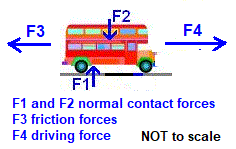
A Q13 The
engine of a double-decker bus weighing 20 000 N
generates a driving force of 2000 N against opposing friction forces of 1500 N.
(a)
Draw a free body diagram of the four forces involved and explain their
origin.
(b) Calculate the resultant force
(c) Calculate the acceleration of the bus
(this requires much more advanced knowledge
ANSWERS |
TOP OF PAGE
APPENDIX 1:
right angle triangle rules
 Important formulae in the trigonometry of a
right angled triangle:
for angle θ shown on the right diagram
tangent rule: tan θ = opposite / adjacent
sine rule: sin θ = opposite / hypotenuse
cosine rule: cos θ = adjacent / hypotenuse
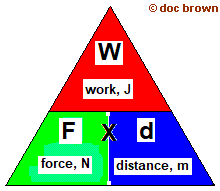 APPENDIX
2 Calculating work done from a resultant force
If a source of energy is available, you can
calculate the work done from the acting force and the distance the force acts
through.
work done (joules) = force (newtons) x
distance along the line of action of the force (metres)
W (J) = F (N) x d (m), F =
W/d, d = W/F
SET B
QUESTIONS for you to do
B
Q1
If you drag a heavy box with a force of 200 N across a floor for 3 m, what
work is done?
ANSWERS TO SET B QUESTIONS
B Q2 If a machine part
does 500 J of work moving linearly 2.5 m, what force was applied by the
machine?
ANSWERS TO SET B QUESTIONS
B Q3 Part of a machine requires a continuous resultant force of
500 N from a motor to move it in a linear direction.
ANSWERS TO SET B QUESTIONS
B Q4 A toy model car has a clockwork motor, whose spring can
store 8.75 J of elastic potential energy.
On release the clockwork motor can
deliver a continuous force of 2.5 N.
ANSWERS TO SET B QUESTIONS
These examples were 'borrowed' from
Types
of energy stores, mechanical work done and power calculations
Key points
about
calculating
resultant forces using graphs, vector diagrams and work done
Information
sources for Doc Brown's key points: IGCSE-GCSE physics are based on
textbooks & syllabus-specifications for students taking the UK AQA, Edexcel,
OCR 21st Century Science, OCR Gateway science suite, WJEC, CCEA and CIE GCSE
physics 9-1 level science examinations
Here's a structured set of summary revision notes on
calculating resultant forces using graphs, vector diagrams, and
work done, tailored to the GCSE/IGCSE Physics
specifications across WJEC, CCEA, CIE, AQA, Edexcel, and OCR:
Core Concept: Resultant Force
- Definition: The single force that has the same
effect as all the individual forces acting on an object.
- Balanced Forces: Resultant force = 0 → object
remains stationary or moves at constant velocity.
- Unbalanced Forces: Resultant force ≠ 0 → object
accelerates or changes direction.
Graphical Methods
1.
Force Diagrams
- Arrows represent forces (length = magnitude, direction = force
direction).
- Use free-body diagrams to show all forces acting on
an object.
2.
Force versus Extension Graphs
- Used in spring experiments (Hooke’s Law).
- Gradient = spring constant ( k )
- Area under graph = work done (elastic potential
energy).
Vector Diagrams
Scale Drawing Method
- Draw forces tip-to-tail using a scale (e.g. 1 cm =
10 N).
- Resultant force = arrow from start of first vector to end of last.
- Use ruler to measure magnitude and protractor for direction.
Resolving Forces
- Break angled forces into horizontal and vertical components.
- Use trigonometry:
- Combine components to find resultant using Pythagoras:
Work Done by a Force
- Equation:
W = F x d
Where:
- W = work done (J)
- F = force (N)
- d = distance moved in direction of force (m)
Work done = energy transferred.
This equation applies to stretching springs,
moving objects, lifting weights.
Typical Exam Board Specification Content
|
Coverage |
| Resultant forces, vector diagrams,
work done, free-body diagrams. |
| Force diagrams, scale drawings,
work done, energy transfers. |
| Vector resolution, resultant
force, work done calculations. |
| Resultant force, vector
diagrams, practical applications. |
| Force diagrams, vector addition,
work done in mechanical systems. |
| Resultant force, vector
resolution, work done, graphical analysis. |
Student Tips
- Practise drawing vector diagrams to scale —
accuracy matters!
- Use geometry tools: ruler, protractor, compass for
scale drawings.
- Revise practicals: spring extension, force versus
distance, energy transfer.
- Understand equilibrium: zero resultant force =
balanced forces.
- Use consistent units: N for force, m for distance,
J for energy.
- Link to motion: resultant force causes acceleration
(Newton’s Second Law).
Keywords, phrases and learning objectives for forces
Problem solving calculating resultant forces using graphs and
vector diagrams
TOP OF PAGE
WHERE
NEXT?
See also
What are contact forces &
non-contact forces?, scalar & vector quantities, free body force diagrams
ALL my Physics Notes
Find your GCSE
science course for more help links to revision notes
This is a BIG
website, you need to take time to explore it [Website Search
Box]
email doc
brown
What next?
Forces revision notes index
FORCES 1. What are contact forces &
non-contact forces?, scalar & vector quantities, free body force diagrams
FORCES
2. Mass and the effect of gravity force on it - weight, (mention of work done and
GPE)
FORCES 3. Calculating resultant forces using vector
diagrams and work done
FORCES
4.
Elasticity and energy stored in a spring
FORCES 5. Turning forces and moments - from spanners
to wheelbarrows and equilibrium situations
FORCES 6. Pressure in liquid fluids and hydraulic
systems
FORCES 7. Pressure & upthrust in liquids, why do
objects float or sink in a fluid?, variation of atmospheric pressure with
height
HOME PAGE of Doc Brown's Science
Basic Science Quizzes for
UK KS3 science students aged ~12-14, ~US grades 6-8
Biology * Chemistry
* Physics for UK
GCSE level students aged ~14-16, ~US grades 9-10
Advanced Level Chemistry
for pre-university age ~16-18 ~US grades 11-12, K12 Honors

ting
forces and work done calculations IGCSE revision
notes working out resultant forces KS4 physics Science notes on working out
resultant forces GCSE physics guide
notes on working out resultant forces for schools colleges academies science course tutors images
pictures diagrams for working out resultant forces science revision notes on
working out resultant forces for revising physics modules physics topics notes to help on understanding of
working out resultant forces university courses in physics
careers in science physics jobs in the engineering industry
technical laboratory assistant
apprenticeships engineer internships in physics USA US grade 8 grade 9 grade10 AQA
GCSE 9-1 physics science revision notes on working out resultant
forces GCSE
notes on working out resultant forces Edexcel GCSE 9-1 physics science revision notes on
working out resultant forces for OCR GCSE 9-1 21st century
physics science notes on working out resultant forces OCR GCSE
9-1 Gateway physics science
revision notes on working out resultant forces WJEC gcse science CCEA/CEA gcse science
how to calculate the work done from a resultant force |


 However, you can avoid the parallelogram of forces
diagram by drawing the force diagram in a simpler way as shown in
diagram B.
 In
situation C I want you to imagine the 300 N force acting in the opposite
direction.
 (a)
 (a)
Draw a free body diagram of the forces involved and explain their
origin.

