|
GCSE level Biology exam revision note on ecology & surveying
Surveying ecology :
Part 5.
Estimating a population size by using a capture-recapture technique and
methods of capturing animals e.g. pooter, pitfall trap and sweep net for
biodiversity surveying
[Author
©
Dr Phil Brown PhD:
Doc Brown's biology exam revision notes suitable for students of UK
IGCSE & GCSE level biology courses & ~ US grades 9-10 biology
[survey page updated
April 16th 2026 *]
[email doc
b: comment? query?]
*
[privacy & cookies policies & disclaimer] * ]SEARCH]
[Key
points and learning objectives for this page, after the main body of
notes]
INDEX
of biology notes on ecological surveying and biodiversity
(5A) Ecological surveying Method 4.
Estimating a population size by using a capture-recapture technique and
subsequent calculation for biodiversity surveys
See also next section on trapping animals.
capture (1st number) ==> mark ==> release ==> recapture
(2nd number)
to estimate the size of the population of the animal.
You set a trap of some sort that is likely
to capture, without harm to them, the animal whose population
you wish to estimate. (see next section for methods of trapping)
After capturing your 1st sample of the population,
count them and mark them in some harmless way and release them
back into their habitat - their local environment.
You then set the same trap in the
same place, same time of day and leave for the same time as the
first experiment to get a 2nd sample of the animal.
Therefore you have recaptured a 2nd
sample of the population.
You then count how many of
them are marked from the first sample.
The population size is estimated from
the formula
| |
|
number in 1st sample x number in 2nd sample |
| Population size |
= |
---------------------------------------------------------------------------------- |
| |
|
number in 2nd
sample previously marked in 1st sample |
The calculation is quite simple (unlike the capturing
and marking!)
Suppose 40 of a specific animal were caught in a
trap in 1 hour.
The next day, at the same time, 35 of the same
animal were caught in 1 hour for the 2nd sample.
If 7 of the 2nd sample were marked from the 1st
sample, calculate the size of the population.
population size = 40 x 35 / 7 = 400
This is not very accurate because of
several assumptions made:
There has been no change in
population size - best done in consecutive days with the same
weather conditions - less time for births/deaths between counts.
The markings haven't affected the
chance of the animals survival - bright colours not recommended -
makes them more visible to predators!
(5B) Three ways
of trapping animals
 1.
A pooter for catching insects
A pooter is a simple device for collecting
insects on the ground - no good if they are flying around! The
pooter consist of a bottle/tall beaker with the sealed with a larger
rubber bung. Two plastic/glass tubes pass through the bung.
The idea is to put the longer tube end over an insect and suck on
the shorter tube to capture the insect. The shorter tube
contains a fine mesh so that you don't suck the insect into your
mouth.
You can investigate several contrasting areas
and suck in as many insects as you can in a given time e.g. 5
minutes. Count the number of insects caught and then repeat
in another selected area of the same size - which could be
the area in a 1 m2 quadrat.
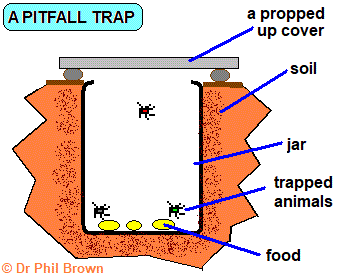 2.
A pitfall trap to catch insects
A pitfall trap consists of a steep-sided
container like a tall jam jar, which is sunk into a hole in the
ground of the habitat you are investigating e.g. part of a field or
your own garden! The top of the container is covered with a
raised cover which allows for the trap to be partly open. Any
creature wandering in, falls down into the trap, but can't escape
because of the steep sides of the container. The cover also
protects the trap from the weather.
You leave the pitfall trap overnight in the
first selected area and in the morning you can count the number of
insects trapped. The following night you can select another
area to sample and compare the results. You leave the traps in place
for the same time. You could leave the trap in the same place and
compare daytime and nighttime or at the same time period of daytime
in different weather conditions.
3.
Using nets to catch animals (e.g. insects or fish)
There are also sorts of nets depending on what
you want to catch and where.
A sweep net is a made of a strong cloth
mesh that can be swept through long grass, nettles or reeds to catch
weevils, plant bugs, leafhoppers, beetles, spiders, wood wasps and
even snails!
You stand still in your chosen sample area
and sweep the net once from left to right through vegetation.
You then have to quickly sweep the net up
and turn the contents of the net into a container to count the
insects - or whatever else you catch.
You then repeat the sweep in a second
location and compare the numbers of the two catches.
For aquatic locations you can use a simple
pond net, usually made of a plastic mesh - the size of the mesh
can be varied depending on what you want to catch.
With a pond net you can catch insects,
small fish, water snails and other animals from ponds and
rivers.
Like with the sweep net, stand in your 1st
location and sweep the net along the bottom of the pond and
river.
Turn the contents of the net out into a
white dish and count the organisms you have caught.
Repeat the pond net sweep in another
location and repeat the count via the white dish.
This allows you to compare several
different locations in the same habitat e.g. near the bank of
further out in deeper water (take care!).
Most moth traps use a light source to
attract moths into a trap at night. Pheromone traps are also used.
All moth traps have the same basic design using a powerful lamp
light to attract the moths and a box (not a net) in which the moths
get trapped for later examination.
Key points -
Based
on the syllabus-specifications for students taking the UK AQA, Edexcel and
OCR GCSE level biology examinations (~US grades 9-10 biology).
Revision notes
for biology students on Estimating Population Size Using the
Capture-Recapture Method, plus common animal capture
techniques like pooters, pitfall traps, and nets.
Estimating Population Size –
Capture-Recapture Method
This method is used for
animals that move and are difficult to count directly (e.g.
insects, small mammals).
How Does It Work?
-
Capture
a sample of animals.
-
Mark
each one harmlessly (e.g. waterproof paint, tags) and release them back
into the wild.
-
Wait a set amount of time
to allow the marked individuals to mix back into the population.
-
Recapture
another sample and count:
Population Size Formula:
Estimated Population Size
=
(Number in 1st sample) x
(Number in 2nd sample) / (Number marked in 2nd sample that were also
marked in 1st sample)
Example:
Estimated population = (40
x 30) / {10} = 120
Assumptions of the Method
-
No immigration/emigration
between samples.
-
No births or deaths
affecting the population.
-
Marking doesn’t affect the
animal’s chances of survival.
-
Enough time is given for
marked animals to mix randomly.
Methods of Capturing Animals
1.
Pooter
(for small insects)
-
A small jar with two
tubes:
-
Used to safely collect
tiny, flying, or crawling insects (e.g. ants, beetles).
-
Common in grassy or leafy
habitats.
2.
Pitfall Trap
(for ground-dwelling invertebrates)
-
A cup or container buried
with its rim at soil level.
-
Creatures fall in and
cannot climb out.
-
Covered with leaves/stones
to prevent rain and predators.
-
Used for slugs,
beetles, ants, etc.
3.
Sweep Net
(for taller grasses and shrubs)
-
A sturdy net used to sweep
through long grass or bushes.
-
Good for catching flying
insects and small invertebrates.
-
Be gentle - capture,
observe, then release!
Exam Tips
-
Make sure you know
the formula for population estimation and how to apply it.
-
Understand why
marking should not affect the animal (e.g. doesn't hurt or
change behavior).
-
Know which tool is
suitable for which type of organism/habitat.
-
Be ready to
evaluate reliability: "This method assumes a closed
population."
Keywords, phrases and learning objectives for this part on ecological surveying
and biodiversity
In the context of surveying in ecology, know how to
estimate population size using a
capture-recapture, and describe various methods of capturing animals
e.g. using a pooter, a pitfall and net capturing techniques.
WHAT NEXT?
TOP OF PAGE
INDEX
of biology notes on ecological surveying
INDEX of all my BIOLOGY NOTES
This is a BIG website, so try using the [SEARCH
BOX], it maybe quicker than the many indexes!
email doc
brown - comments - query?
Basic Science Quizzes for
UK KS3 science students aged ~12-14, ~US grades 6-8
Biology * Chemistry
* Physics for UK
GCSE level students aged ~14-16, ~US grades 9-10
Advanced Level Chemistry
for pre-university age ~16-18 ~US grades 11-12, K12 Honors
Find your GCSE/IGCSE
science course for more help links to all science revision notes
Revision notes on describing explaining
how pooter, pitfall trap & sweep net capture-recapture methods work based on the syllabus-specifications
for students taking IGCSE/GCSE level biology examinations, summary
revision notes and key points on describing explaining how pooter,
pitfall trap & sweep net capture-recapture methods work for students taking the AQA
igcse/gcse biology notes on describing explaining how pooter, pitfall trap &
sweep net capture-recapture methods work, Edexcel gcse
biology notes on describing explaining how pooter, pitfall trap &
sweep net capture-recapture methods work, OCR 21st century GCSE
biology notes on describing explaining how pooter, pitfall trap &
sweep net capture-recapture methods work, OCR gateway
GCSE biology notes on describing explaining how pooter, pitfall trap
& sweep net capture-recapture methods work, WJEC gcse biology notes on
describing explaining how pooter, pitfall trap & sweep net
capture-recapture methods work, CCEA
gcse biology notes on describing explaining how pooter, pitfall trap &
sweep net capture-recapture methods work for students taking CIE Cambridge igcse
biology, exam revision notes on
describing explaining how pooter, pitfall trap & sweep net
capture-recapture methods work, useful for US grade 9-10 biology courses,
importance of estimation population
data using capture-recapture methods
in GCSE level biology, What you need to know about estimation population
data using capture-recapture methods for
GCSE level
biology,
Explaining the use of estimation population data using capture-recapture
methods knowledge in GCSE level biology, Examples of estimation
population data using capture-recapture methods explained
when studying GCSE level biology, What is
significant about estimation population data using capture-recapture
methods, describing the theory of estimation population data
using capture-recapture methods when studying
GCSE level biology, revision notes for estimation population data using
capture-recapture methods in exams, online exam help
for estimation population data using capture-recapture methods, revision notes about
estimation population data using capture-recapture methods, what do I need to learn about
estimation population data using capture-recapture methods for
by GCSE biology exam?
help to understand the estimation population data using
capture-recapture methods topic in preparation for GCSE biology exam
question, how to
prepare for questions involving estimation population data using
capture-recapture methods in a GCSE biology examination?
SITEMAP Website content © Dr
Phil Brown 2000+. All copyrights reserved on Doc Brown's biology revision notes, images,
quizzes, worksheets etc. Copying of website material is NOT
permitted. Exam revision summaries and references to science course specifications
are unofficial.
|
